

There is a particular genre of content marketing advice – you will have encountered it at conferences, in LinkedIn carousels, possibly tattooed on the forearm of someone who describes themselves as a “growth hacker” – that insists you need fourteen tools, three automation layers, and a custom GPT before you can write a blog post. Livia Hirsch, a B2B content strategist who helps scale-ups expand into the US market, has apparently not received the memo. Her actual production stack is so modest it borders on an act of civil disobedience against the martech industrial complex. In a conversation with Sophie Steffen, she walked through every tool she touches from blank page to publication, and the result is the sort of inventory that makes software vendors weep quietly into their quarterly projections.
The Core Four: Miro, SEMrush, Google Docs, Notion
Livia’s personal stack could fit on a Post-it note with room to spare. Miro handles strategy and brainstorming sessions with clients. SEMrush covers keyword research and competitor analysis. Google Drive and Google Docs are where every piece of content lives, from first outline to final version. A Notion calendar ties the workflow together and provides a shared view. That is the entire apparatus – four tools, one of which is essentially a fancy folder system. Presumably the martech conference circuit will not be inviting her to keynote about this setup anytime soon.
Notice what is missing. There is no project management platform. No Gantt charts stretching optimistically into the future. No automated approval workflows with seventeen stakeholders. Livia keeps Google Docs as her “best friend,” which is the sort of relationship that nobody posts about on LinkedIn but that apparently gets more work done than any enterprise license ever has. Her version control system consists of three files in a folder – V1, “with edits,” final version – and it functions because she limits her feedback loop to one designated contact person per client, not a committee of people who all want to weigh in on font choices. The leanness, she says, is deliberate. Every tool solves exactly one problem, and she does not add tools to solve problems she does not have. This is worth noting in an industry that treats tool adoption as a personality trait and stack complexity as evidence of professional seriousness.
When Clients Bring Their Own Stack
The stack expands only when clients bring their own ecosystem, which they invariably do, in the way that clients invariably do things – without asking whether you have feelings about it. Livia has been embedded in WordPress, Wix, and HubSpot as CMS platforms. She has used Asana and ClickUp for project management. She briefly used Jasper, a fact she mentions without dwelling on it in the way one might mention a brief encounter with food poisoning. None of these were her choice.
The ability to walk into any client’s tool ecosystem and start producing content immediately is, it turns out, a competitive advantage that nobody puts on their LinkedIn headline. A freelance strategist who demands everyone adopt her preferred setup is, as Livia implicitly understands, a freelancer who will not be freelancing for very long. The tools are not the work. The process around them is the work. You would think this distinction would be obvious, but the content marketing industry has spent the better part of a decade pretending otherwise, and here we are.
White Papers Need NotebookLM, Not More AI
For heavyweight content like white papers, one additional tool enters the picture, and it is not the one the AI evangelists would have you expect. NotebookLM from Google became Livia’s research companion for a specific and, frankly, refreshingly boring reason: it stays confined to the sources you give it. You upload ten research papers, and the chat only discusses those ten papers. No hallucinated citations. No invented statistics. No cheerful fabrication of McKinsey reports that do not exist. In a landscape where AI tools compete to be the most confidently wrong, NotebookLM’s defining feature is that it knows when to shut up.
“It helps with preventing hallucinations because you’ve given it these 10 sources, we’re just talking about these 10 sources. That’s a must at this point for all heavy research.”
The design phase typically adds Figma or InDesign, whichever the designer prefers. Livia preps visual suggestions directly in Google Docs comments during the writing process – flagging which statistics should be highlighted, which case studies deserve an infographic. The handoff to design is baked into the writing, not bolted on three days later when everyone has forgotten what the piece was about. It is the sort of unglamorous forethought that separates professionals from people who post about “seamless collaboration” while sending panicked Slack messages at midnight.
Distribution: LinkedIn and Email, Nothing Else
Distribution, in Livia’s world, involves two channels. LinkedIn and email. That is the list. She has never done TikTok content for a B2B client, which in 2026 qualifies as either a principled stand or a failure of imagination, depending on which conference panel you ask. Content fits into an established cadence – two or three posts per week – rather than being frantically pushed live the moment it publishes, because apparently nobody’s LinkedIn feed has ever been improved by urgency.
HubSpot handles scheduling for both social posts and newsletters. Mailchimp is the alternative for email-focused clients. The one genuine friction point in this otherwise streamlined operation is almost comically petty: scheduled posts struggle to tag people properly. You write a thoughtful LinkedIn post thanking your interview subject, schedule it through HubSpot or any other tool, and half the time the tag simply does not render. LinkedIn, it seems, prefers you to be physically present when you post, like a restaurant that insists on eye contact before seating you.
Livia’s workaround is attitudinal rather than technical. Write the LinkedIn posts and email blurbs while you are still in the headspace of the article, batch the distribution content alongside the main production, and accept that you may need to manually fix a tag or two. It is not a workflow that will ever be featured in a case study about marketing automation. It is, however, a workflow that actually works, which in this industry is apparently the harder bar to clear.
For the full interview breakdown, see our complete Expert Insight with Livia Hirsch.
Tools Mentioned in the Interview
The following tools and platforms were referenced during this conversation.
Related Content
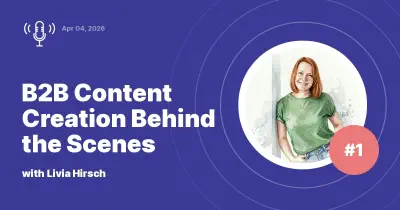
B2B Content Creation Behind the Scenes: Expert Insights with Livia Hirsch
Livia Hirsch, a B2B content strategist who helps scale-ups expand from local to global brands, breaks down the tools, workflows, and hard-won lessons that separate content that converts from content that just exists.

The SME Interview Workflow: From Scheduling to Final Draft
The hardest part of expert-driven content is not the writing. It is getting a busy subject matter expert to block 30 minutes on their calendar.
Content Metrics That Actually Matter in B2B
There is no single metric that matters in B2B content. Livia Hirsch explains which dashboards she builds, which numbers she ignores, and why 3 LinkedIn likes are not a crisis.


